



IVF Cycle Steps: Your Simple 8-Stage Guide

Quick Takeaways
- An IVF cycle has 8 main steps, from fertility screening to your pregnancy test
- Most cycles take 4–6 weeks from first injection to embryo transfer
- Specific medications are used at each stage — knowing which ones helps you feel prepared
- IVF is more than a medical procedure — it’s one of the most emotionally intense experiences a person can go through
The IVF cycle steps can feel overwhelming at first, but once you see the full picture, the process becomes a lot easier to manage. For the families going through it, IVF is more than science — it’s resilience, patience, and hope showing up every single day. This guide breaks down each stage so you know exactly what’s coming and what it may feel like.
What Are the IVF Cycle Steps?
Contents
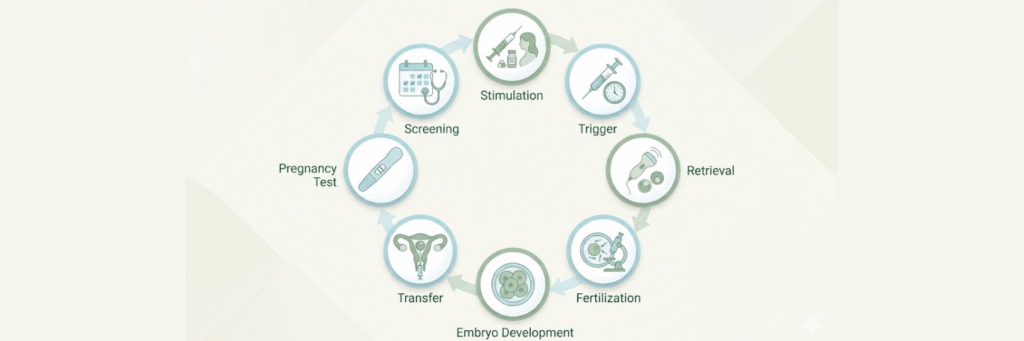
Most IVF cycles follow 8 main stages. Your clinic may adjust the order slightly based on your protocol, but the core steps stay the same. You can also read more about how the IVF process works for a deeper look at the clinical details.
- Fertility Screening — Blood tests, ultrasounds, and semen analysis establish your starting point
- Protocol Planning — Your specialist maps out a personalized medication and timing plan
- Ovarian Stimulation — Daily hormone injections encourage your ovaries to grow multiple follicles
- Trigger Shot — A timed injection preps the mature eggs for retrieval
- Egg Retrieval — A short procedure collects the eggs under light sedation
- Fertilization & Embryo Development — Eggs and sperm are combined in a lab and monitored for 3–5 days
- Embryo Transfer — The healthiest embryo is placed into the uterus
- Pregnancy Test — A blood test 10–14 days after transfer gives you the result
What Does the Emotional Side of IVF Cycle Steps Feel Like?
Nobody talks enough about the waiting. Between each step, there are days — sometimes more than a week — where you’re just sitting with hope and anxiety at the same time. The stimulation phase can feel physically draining, the trigger shot night feels surreal, and the two-week wait after transfer is genuinely one of the hardest stretches of the whole cycle.
You may feel fine one day and completely overwhelmed the next, that’s normal and you are not alone in this. According to RESOLVE: The National Infertility Association, emotional support during IVF is just as important as the medical care itself. Give yourself permission to feel all of it.
Which Medications Are Used During IVF Cycle Steps?
The right medications at the right time are what make the IVF cycle steps work. Here’s a simple breakdown by stage:
- Stimulation: FSH stimulation medications like Gonal-F or Fostimon are injected daily to grow follicles. HMG medications like Menopur are often added alongside them.
- Suppression: GnRH antagonists like Cetrotide or Orgalutran prevent premature ovulation during the stimulation window.
- Trigger: The IVF trigger shot — usually Ovitrelle (Ovidrel) or HCG — is timed precisely 36 hours before egg retrieval.
- Luteal support: After embryo transfer, progesterone helps maintain the uterine lining. Progestan 200 mg is a commonly prescribed option available through Fast IVF at significantly lower prices than US retail.
Browse the full guide to IVF medications used across different stimulation protocols for a deeper breakdown of each drug class.
How Long Does One IVF Cycle Take?
From your first injection to your pregnancy test, most cycles take 4–6 weeks. The stimulation phase alone runs 8–14 days. Add a few days for retrieval and lab work, then the transfer, then the two-week wait. If a frozen embryo transfer (FET) is planned instead of fresh, there may be a rest cycle in between — which adds time to the overall timeline.
Planning your medication order well in advance matters. Shipping from Fast IVF typically takes 3–5 business days, so ordering two weeks before your cycle starts is the smartest move to avoid delays.
Frequently Asked Questions
How many steps are in a typical IVF cycle?
Most IVF cycles have 8 main steps: fertility screening, protocol planning, ovarian stimulation, trigger shot, egg retrieval, fertilization and embryo development, embryo transfer, and a pregnancy test. Your clinic may adjust this based on your specific situation and protocol.
What medications are used during IVF cycle steps?
Common IVF medications include FSH injections like Gonal-F or Fostimon for stimulation, GnRH antagonists like Cetrotide or Orgalutran for suppression, an HCG trigger shot like Ovitrelle, and progesterone like Progestan 200 mg for luteal phase support after the embryo transfer.
How long does one IVF cycle take from start to finish?
A typical IVF cycle takes 4–6 weeks from the first injection to the pregnancy blood test. Frozen embryo transfer cycles may take longer depending on your clinic’s protocol and whether a rest cycle is needed in between.
Is it normal to feel overwhelmed during the IVF process?
Absolutely. The emotional weight of IVF is real and often underestimated. Anxiety, hope, and exhaustion are all common throughout the cycle — especially during the two-week wait. Speaking to a counselor or connecting with an IVF support group can make a genuine difference.
Can I order my IVF medications online through Fast IVF?
Yes. Fast IVF is an international IVF medication provider that ships European brand-name medications at a fraction of US retail prices. Orders are processed within 3–5 business days with temperature-controlled packaging where needed. Get a free quote to see exact pricing for your protocol.
Ready to plan your medications before your cycle begins? Request a free Fast IVF quote — send us your prescription and we’ll take care of the rest.