



Does Birth Control Affect Getting Pregnant?

TL;DR – Quick Summary
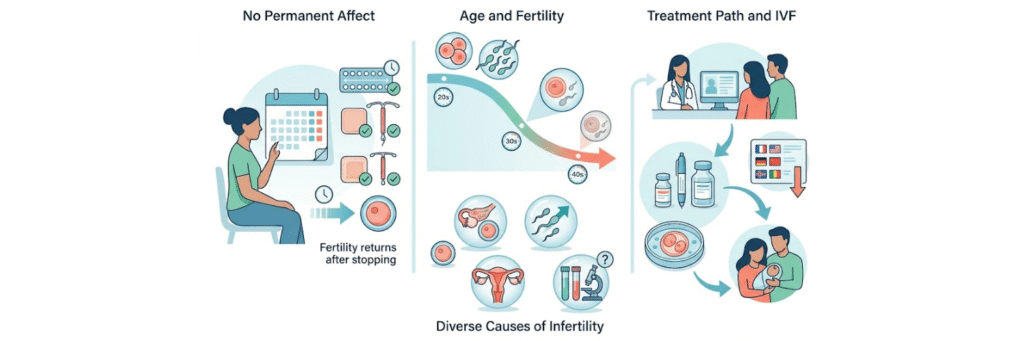
- Birth control does not permanently affect your fertility
- It may take a few weeks to a few months for your cycle to return to normal after stopping
- Age is a much bigger factor in fertility decline than any birth control method
- If you’ve been trying for 12 months without success (6 months if over 35), see a doctor
- IVF is an option when natural conception isn’t working – medications are a key part of the process
If you stopped birth control and pregnancy hasn’t happened yet, it’s natural to wonder whether the two are connected. The short answer is: birth control doesn’t cause lasting fertility problems. But there’s more to it than that – here’s what the research actually says.
Does Birth Control Affect Your Ability to Get Pregnant?
Contents
No. Multiple studies have found no meaningful difference in pregnancy rates between women who used hormonal contraceptives and those who never did. The pill, vaginal rings, patches, and hormonal implants are all designed to be reversible – once you stop using them, your body works toward returning to its natural cycle.
That said, “reversible” doesn’t always mean “immediate.” It’s not unusual for ovulation to take a few months to normalize after stopping hormonal birth control. Some women resume regular cycles within weeks; others wait up to four months. That delay is normal and is not the same as infertility.
What About the IUD?
Hormonal IUDs work the same way – fertility typically returns quickly after removal. Copper IUDs are non-hormonal and have no effect on your cycle at all. In both cases, your fertility returns to its pre-IUD baseline once the device is out.

So Why Isn’t Pregnancy Happening?
If you’ve been off birth control for several months and haven’t conceived, birth control probably isn’t the reason. The more likely factors are age, ovulation issues, sperm quality, or other underlying conditions. Infertility is defined as the inability to conceive after 12 consecutive months of unprotected sex – or 6 months if you’re over 35. At that point, it’s worth talking to a reproductive specialist.
Age is the most significant factor most people underestimate. Egg quality and quantity decline with age, and this process starts earlier than many people expect – well before 40. If you’re in your mid-to-late 30s and trying to conceive, time matters more than any birth control history.
What Are Your Options If You’re Having Trouble Conceiving?
Start with your OB-GYN or a reproductive endocrinologist. They’ll evaluate both partners and identify whether there’s a treatable cause. Depending on what they find, options range from lifestyle changes and timed intercourse to IUI or IVF.
For couples where IVF is recommended, understanding how the IVF process works is a good first step. It involves ovarian stimulation with IVF medications, egg retrieval, fertilization in a lab, and embryo transfer. Many patients are surprised to find that the medications – one of the biggest cost drivers — can be sourced internationally at a fraction of US retail prices.
Frequently Asked Questions
How long after stopping birth control should I expect to get pregnant?
Most women ovulate within 1–3 months of stopping hormonal birth control. Pregnancy can happen in that first cycle or take several months — both are normal. If nothing has happened after 12 months of trying (or 6 months if you’re over 35), schedule an appointment with a fertility specialist.
Can the pill cause long-term fertility problems?
No. The pill suppresses ovulation while you’re taking it, but it does not deplete your egg supply or cause permanent hormonal changes. Decades of research support this. Any delay you experience after stopping is temporary.
Does birth control affect IVF success rates?
Past birth control use has not been shown to affect IVF outcomes. In fact, some IVF protocols use birth control pills at the start of a cycle specifically to regulate timing and coordinate follicle development. Your history of contraceptive use is generally not a concern going into IVF.
What causes infertility if it’s not birth control?
The most common causes include ovulation disorders, blocked fallopian tubes, endometriosis, low ovarian reserve, and male-factor issues like low sperm count or motility. Our overview of what you should know about infertility covers the main causes and when to seek help. For male-specific factors, see our post on male infertility myths.
How can I save money on IVF medications?
IVF medications are one of the largest out-of-pocket expenses in a treatment cycle. Fast IVF supplies European-sourced IVF medications at significantly lower prices than US retail. Get a fast quote to see what your specific protocol would cost.