


First Visit to a Fertility Specialist: 5 Ways to Prep
Quick Takeaways
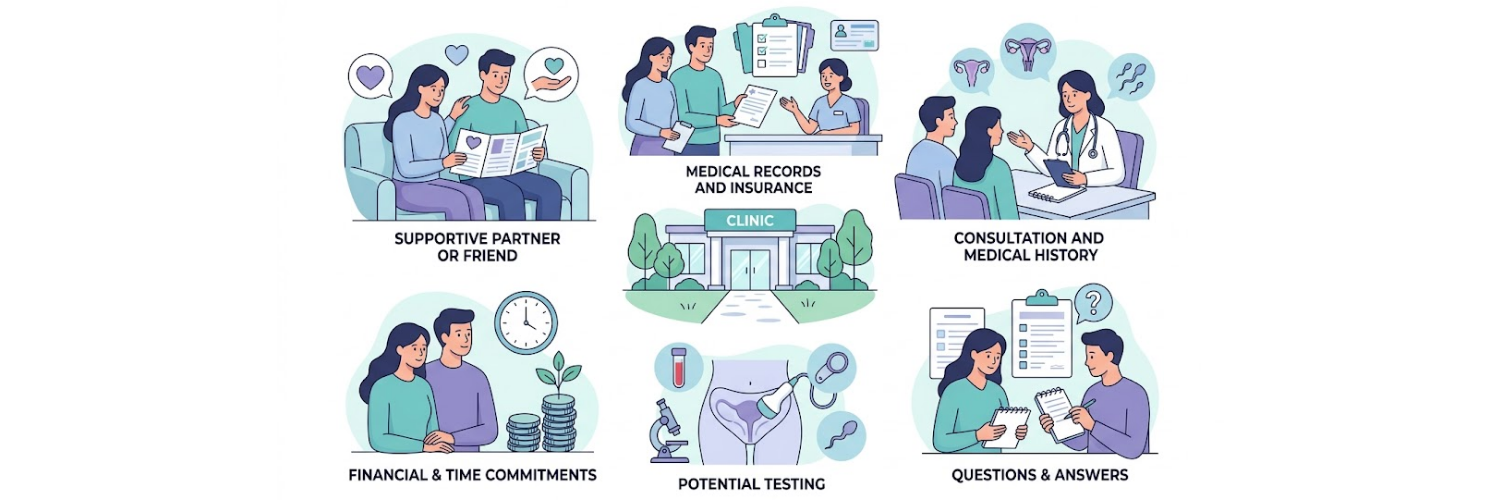
- Your first fertility specialist visit covers three things: introductions, medical history, and deciding if further testing is needed.
- Bring your partner if you have one — clinics strongly recommend it.
- Come prepared with medical records, insurance cards, a medication list, and your questions written down.
- Be ready to discuss your financial and time commitments — this helps your care team build a realistic treatment plan.
- The first appointment is about information gathering, not pressure — you won’t be asked to make major decisions on the spot.
About 1 in 8 couples in the US experience some difficulty conceiving. If you’ve been trying without success, scheduling a first visit to a fertility specialist is the most productive next step — it replaces uncertainty with actual information. Here’s exactly what to expect and how to prepare so you get the most out of that first appointment.
What Happens at Your First Fertility Specialist Visit?
Contents
- What Happens at Your First Fertility Specialist Visit?
- Should You Bring Your Partner to the First Appointment?
- What Should You Bring to Your First Fertility Appointment?
- What Questions Will the Doctor Ask You?
- What Are the Financial and Time Commitments to Discuss?
- Frequently Asked Questions About the First Fertility Specialist Visit
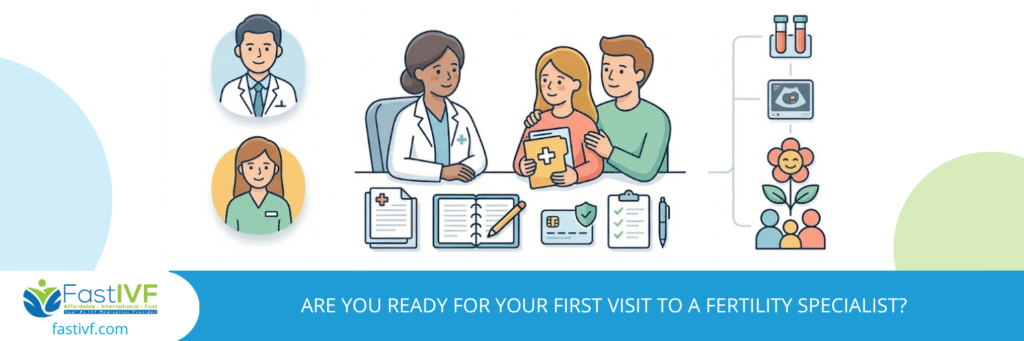
Every clinic runs things a little differently, but the structure of a first fertility appointment is fairly consistent. The visit typically covers three things:
- Introductions: You’ll meet the care team — your reproductive endocrinologist, a nurse coordinator, and often a patient care or financial counselor. This is also your chance to get a feel for the clinic’s communication style and whether you feel comfortable there.
- Medical history review: Your doctor will go through your reproductive history, cycle regularity, prior pregnancies or losses, any known medical conditions, and medications. If your partner is there, their history is collected too — male factor infertility is involved in roughly 40–50% of cases, so both partners are evaluated from the start.
- Determining next steps: Based on your history, your doctor will recommend specific tests — bloodwork, a transvaginal ultrasound, semen analysis, or additional imaging — to build your treatment plan. You likely won’t leave with a full protocol, but you will leave with a clear roadmap of what comes next.
Understanding the basics of how the IVF process works before your appointment helps you ask better questions and follow the conversation more easily.
Should You Bring Your Partner to the First Appointment?
Yes — most fertility clinics strongly recommend it. There’s a lot of information covered in a short time, and having a second person listening helps you retain more of it. Fertility treatment is also emotionally demanding, and starting the process as a team sets a better foundation for everything that follows.
If you’re going through treatment without a partner, bringing a trusted friend or family member is just as valuable. The emotional weight of infertility is real and worth acknowledging early. Our guide on emotions and infertility covers how to manage the psychological side of the process alongside the medical one.
What Should You Bring to Your First Fertility Appointment?
Coming prepared makes the appointment more productive for everyone. Bring:
- Medical records: Records from your OBGYN, primary care physician, and urologist if applicable. Include any prior fertility evaluations, surgeries, or treatments.
- Insurance cards: And any prior authorization paperwork if your insurer requires it for fertility consultations.
- Medication list: All current prescriptions, supplements, and over-the-counter medications for both you and your partner.
- Your partner’s records: Bring whatever is available — even a summary of their general health history is useful.
- A written list of questions: Write them down before you go. Appointments move quickly and its easy to forget things once you’re in the room.
What Questions Will the Doctor Ask You?
Expect questions about how long you’ve been trying to conceive, how regular your cycles are, whether you’ve tracked ovulation, any history of STIs or pelvic infections, prior pregnancies or miscarriages, and family history of reproductive conditions. For the male partner, questions will cover general health, any prior semen analysis results, and lifestyle factors like smoking or heat exposure.
If male factor infertility is a concern, a semen analysis is usually ordered at or shortly after the first visit. This is one of the most important and most commonly delayed tests — don’t wait to get it done.
There may also be a physical exam and bloodwork ordered at the visit. Hormone levels (FSH, AMH, estradiol) give your doctor an early picture of your ovarian reserve and help guide which treatment path makes the most sense.
What Are the Financial and Time Commitments to Discuss?
Before your appointment, have a frank conversation with your partner about what you’re willing to commit — both financially and in terms of time. IVF involves frequent monitoring appointments (sometimes every 1–2 days during stimulation) and can run $15,000–$30,000 per cycle without insurance. Being clear about your boundaries upfront helps your care team build a realistic plan.
Many clinics have financial counselors on staff who can walk you through insurance coverage, financing options, and multi-cycle packages. For a realistic cost baseline before you go, our IVF cost without insurance guide breaks down what a typical cycle actually costs line by line.
Medications are one of the largest and most variable costs — and one of the most controllable. Once your doctor prescribes your protocol, Fast IVF can fill your order with European-brand IVF medications at prices well below US retail. Browse the full product catalog or get a free price quote to compare costs before your cycle starts.
Frequently Asked Questions About the First Fertility Specialist Visit
How do I find a good fertility specialist?
Start with the CDC ART database to check success rates for clinics in your area. Ask your OBGYN for a referral — they usually know which local reproductive endocrinologists have strong reputations. Board certification in reproductive endocrinology and infertility (REI) through ABOG is the key credential to look for. If you’re in California, Florida, or Illinois, our state-specific clinic guides — including best IVF clinics in California and best IVF clinics in Florida — can help narrow your options.
How long does the first fertility appointment take?
Most first consultations run 60–90 minutes. The initial part is a discussion with your doctor covering history and next steps. Depending on the clinic and your cycle day, a baseline ultrasound and blood draw may happen at the same visit, which can extend the appointment. Plan for up to two hours to avoid feeling rushed.
Will I be pressured to start IVF at the first visit?
No reputable clinic will pressure you into a treatment decision at the first appointment. The first visit is diagnostic — the goal is to gather information, not to sell you a protocol. Most patients leave with a recommended testing plan, not a signed treatment agreement. Take your time, ask questions, and don’t hesitate to seek a second opinion before committing to anything.
What if I’m not ready to start treatment right away?
That’s completely fine. The first visit doesn’t obligate you to do anything. Some patients do the workup, learn what’s involved, and decide to try naturally for a few more months. Others start immediately. The value of going early is that you’ll have real information to work with — including your ovarian reserve numbers and your partner’s semen analysis — rather than spending more months guessing. Knowing your situation is always better than not knowing.
What IVF medications might be prescribed after my first visit?
It depends on your diagnosis and protocol, but a standard IVF cycle includes FSH stimulation medications like Gonal-F or Menopur, an antagonist like Cetrotide, a trigger shot like Ovitrelle, and progesterone support like Progestan. Once you have a prescription, Fast IVF can supply all of these at significantly lower prices than US pharmacies.